B2B User Research: Methods, Mistakes, and Best Practices (2026)


AI Summary. What’s included?
B2B user research studies how professionals use business software, where the person who buys the product and the person who opens it every morning are rarely the same. This guide covers how B2B differs structurally from consumer research, the three methods that work at small sample sizes, the five mistakes that waste research budgets, and the practices that turn findings into product decisions.
Master B2B user research. Learn the best qualitative methods, how to avoid common enterprise research mistakes, and proven strategies for recruiting niche B2B users.
If UX research is a discipline with different difficulty levels, B2B user research is firmly set to “hard mode.” Consumer apps can recruit hundreds of testers via social media in an afternoon. B2B products, such as enterprise logistics platforms, operate in a completely different reality: scarce participants, complex domain knowledge, high-stakes decisions, and a tangled web of stakeholders with different opinions on what “good” looks like.
Our article is a practical guide for product teams, UX designers, and researchers who work on business software. We’ll cover why B2B UX research demands a different mindset from consumer research, which methods actually work at small sample sizes, the most common traps teams fall into, and the best practices that separate research that drives product decisions from research that collects dust in a shared folder.
Quick Summary (Key Takeaways)
What is B2B user research? B2B user research is the process of studying how professionals interact with business software to complete domain-specific tasks. It requires navigating multi-layered stakeholder dynamics — specifically the critical difference between the economic buyer and the day-to-day end-user.
Top B2B user research methods:
- In-depth interviews (IDIs) — for understanding business processes, pain points, and cross-team dynamics
- Contextual inquiry — observing users in their actual work environment
- Task-based usability testing — evaluating complex workflows with realistic scenarios
Most common mistakes:
- Treating B2B like B2C and conflating buyers with users
- Relying heavily on quantitative data for complex, qualitative workflows
- Skipping domain homework and losing credibility with jargon
Best practices:
- Partner with Sales and Customer Success for recruitment
- Respect participant time with appropriately high-value incentives
- Learn industry terminology before conducting any interviews
B2B vs. B2C User Research: The Fundamental Differences
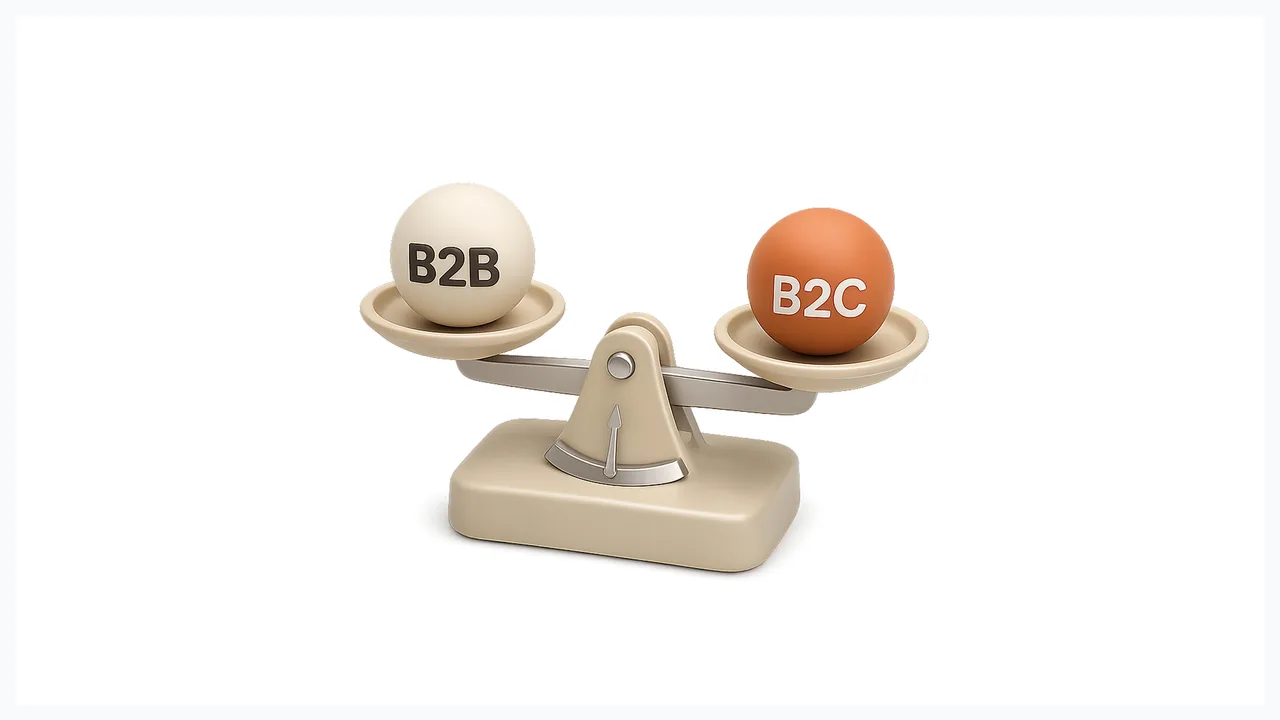
It’s tempting to treat B2B vs. B2C user research as a matter of degree — just harder recruiting and more complex screens. In practice, the differences are structural. The assumptions, methods, incentives, and even the definition of “the user” shift so significantly that approaching B2B research with a B2C playbook is one of the fastest routes to wasted budget and misleading findings.
The Buyer vs. The End-User
This is the single most important distinction in enterprise UX research, and it trips up even experienced teams.
In a B2C context, the person who pays for a product and the person who uses it are almost always the same individual. Someone downloads a meditation app, pays $9.99/month, and uses it before bed. Research subject and economic decision-maker: identical.
In B2B, these roles routinely split — sometimes dramatically. A CFO evaluates and approves a $200,000 annual contract for financial planning software. The people who open that software every morning are the FP&A analysts on her team. The CFO cares about ROI, compliance, and integration with existing systems. The analysts care about whether the pivot-table export actually works and whether the approval workflow has fewer than six steps.
Design exclusively for the buyer, and you’ll close the deal — then watch churn accumulate as daily users quietly work around your product. Design exclusively for the end-user without addressing the buyer’s criteria, and your champion inside the company will never get sign-off. Great B2B UX research maps both personas explicitly and identifies the moments where their needs diverge.
High Domain Complexity and Jargon
Consumer products operate in domains that researchers generally understand. Most UX researchers have used a food delivery app. Far fewer have worked in medical billing, logistics route optimization, or semiconductor inventory management — yet these are exactly the domains where research is most urgently needed, because bad UX in high-stakes professional contexts has real consequences: delayed shipments, billing errors, compliance failures.
This creates a significant onboarding challenge. A researcher who doesn’t understand the difference between an EDI transaction and an API call will struggle to interpret what a warehouse manager is describing during an interview. Domain literacy isn’t optional — it’s a prerequisite for asking useful questions and recognizing meaningful answers.
The Recruitment Challenge
Recruiting for B2C usability studies is a solved problem: post on a panel platform, set demographic filters, and collect 20 participants by tomorrow. B2B user research methods face a different set of constraints. The population of “Senior DevSecOps Engineers at companies with 500-5,000 employees” might number in the thousands globally. Many of them have NDAs that prevent them from discussing their tooling. Their calendars are packed. And a $25 Amazon gift card is an insult, not an incentive.
Recruitment for B2B research typically requires warm introductions, internal champions, and lead times measured in weeks, not days.
The Top 3 Methods for B2B User Research

Because B2B sample sizes are often too small for statistically reliable quantitative analysis, qualitative methods dominate. The goal isn’t to prove a hypothesis across 200 responses — it’s to understand why users behave as they do deeply so that the product team can make confident design decisions.
1. In-Depth Interviews (IDIs)
The gold standard of B2B user research methods. A well-run IDI with one participant can surface more actionable insight than a 500-response survey, because you can probe, follow unexpected threads, and ask “why” five times until you reach the underlying mental model.
For B2B, IDIs are especially valuable for understanding cross-team workflows — the handoffs, the workarounds, the unofficial processes that have evolved because the official software doesn’t quite fit. A 60-minute conversation with a logistics coordinator will reveal the spreadsheet she maintains in parallel to the TMS, since the TMS doesn’t handle split shipments. That spreadsheet is a product roadmap item waiting to be discovered.
Structure IDIs around job-to-be-done frameworks rather than feature feedback. Ask about the task, not the tool. “Walk me through the last time you had to escalate a billing dispute” will generate richer data than “How do you find our dispute resolution interface?”
2. Contextual Inquiry (Shadowing)
Contextual inquiry — observing users doing their actual work in their actual environment — is particularly powerful in B2B because so much of enterprise software behavior is invisible until you see it in context. People don’t describe their workarounds in interviews because they’ve normalized them. They’ll tell you the software works fine. Then you watch them copy and paste data into Excel every morning because the reporting module doesn’t filter by region.
This method is especially relevant for the types of complex B2B products Glow specializes in — logistics, fintech, and SaaS platforms — where understanding the full workflow context is essential to meaningful design decisions. Remote shadowing via screen share has made contextual inquiry more accessible post-pandemic, though nothing replaces sitting next to someone in their actual office environment for at least some sessions.
3. Task-Based Usability Testing
When evaluating whether specific workflows are usable, task-based testing is the method of choice. The critical difference from B2C usability testing is the design of the scenarios. Generic placeholders — “Imagine you’re creating an invoice for Company X” — break the immersion for professional users immediately. B2B participants need highly realistic dummy data: plausible company names, realistic SKUs, invoice amounts in the right order of magnitude, and approval hierarchies that match what they encounter daily.
A Senior Procurement Manager given a task with obviously fake data will mentally switch from “professional solving a work problem” to “person humoring a researcher.” Ecological validity collapses, and the behavioral data you collect reflect that artificial context rather than real working conditions.
For complex enterprise workflows, consider unmoderated testing for initial screening combined with moderated sessions for interpretation. The UI/UX design process at Glow includes usability testing as a formal stage — not an afterthought.
5 Common B2B User Research Mistakes

1. Relying Solely on Sales Feedback
Sales teams are an invaluable resource — and a deeply unreliable source of user insight. Sales hears what prospects say they want during the buying process, which is shaped by what prospects believe will justify the purchase internally. That’s different from how users actually work once the software is deployed. The disconnect between “features that close deals” and “features that reduce churn” is one of the most expensive gaps in B2B product development, and it’s almost impossible to close without direct user research that bypasses the sales filter.
2. Asking Leading Questions
“Would you use a feature that lets you do X in one click?” Yes. Everyone says yes. That’s not data — it’s the question doing the work. Rigorous research earns its value from behavioral observation and open-ended inquiry, not hypothetical preference questions. “Would you use this?” is almost always the wrong question. “Show me how you handle this situation today” is almost always better.
3. Bypassing Gatekeepers
In B2B, the path to research participants runs through Account Managers, Customer Success teams, and sometimes legal departments. Attempting to reach end-users directly without warming up the organizational relationship first is a reliable way to get a polite “no” — or worse, to create friction in a client relationship that the sales team spent months building. Building rapport with the humans who own the client relationship is a prerequisite, not a courtesy.
4. Inadequate Incentives
A $25 gift card communicates that you value a Senior Director’s time at roughly one-tenth of her actual hourly rate. Incentives in enterprise research need to reflect participants’ seniority and opportunity costs. For executive-level users, consider $150-$300 per session. For technical specialists, consider charitable donations in their name, premium tool subscriptions, or early access to new features. The incentive structure also signals how seriously your organization takes the research process.
5. Ignoring the Ecosystem
Enterprise software doesn’t exist in isolation — it lives inside an ecosystem of integrations, data flows, and adjacent tools. A workflow management tool that ignores its users’ Salesforce integration, their SAP backend, and their Slack-based approval processes is being designed in a vacuum. B2B user research methods should always include ecosystem mapping: what does your product connect to, what data it receives, and where its output goes next? Workflow interruptions at integration points are among the most common sources of user frustration — and they’re almost invisible unless you look for them explicitly.
Best Practices for Successful B2B Research

Partner with Customer Success for Recruitment
Customer Success managers know which clients are highly engaged, which are open to feedback conversations, and which are navigating a difficult renewal. They can make warm introductions that convert at far higher rates than cold outreach, and they can help you understand the relational context before you enter a session. In return, share your research findings with CS — they’ll use it to improve their own conversations, and you’ll build an internal ally who makes your next round of recruitment easier. This collaborative model is integrated into Glow’s discovery and design process.
Do Your Homework on Industry Jargon
Credibility is built or destroyed in the first five minutes of a B2B research session. A researcher who confuses “chargeback” with “chargeback rate” in a fintech session, or who doesn’t know what a “lane” means in logistics, will watch participants mentally downgrade the quality of the conversation. Read industry publications, spend time with internal subject matter experts, and review your client’s own documentation before conducting any sessions. The preparation pays back in richer, faster conversations.
Keep Sample Sizes Small but Highly Targeted
In specialized B2B contexts, five highly accurate target users will generate better data than fifty generic respondents who roughly match the demographic. Nielsen Norman Group research on usability testing has long demonstrated that five users uncover the majority of significant usability issues in a qualitative study. In B2B, this principle extends further: a CFO at a mid-market manufacturing company has fundamentally different workflows and mental models from a CFO at a SaaS startup, even though both match the same job-title filter. Specificity in recruitment is more valuable than volume.
Create Safe Environments for Honest Feedback
This is among the most underappreciated challenges in B2B UX research. Enterprise software is frequently mandated from above — employees didn’t choose it and may not like it, but they’re aware that their employer paid significant money for it. Criticizing it in a research session can feel professionally risky, especially if they suspect their feedback might reach their manager.
Establishing genuine psychological safety requires explicit, repeated commitments to anonymity. Explain that findings will be aggregated and that no individual comment will be attributed to them. Conduct sessions through a neutral third party when possible. Make clear that the goal is to improve the product, not to evaluate their performance. Without this groundwork, you’ll collect polished, diplomatic feedback that tells you nothing — and miss the candid insights that would actually drive better design decisions.
Conclusion: Better Research Equals Lower Churn

The gap between what executives buy and what employees actually need is one of the most consistent sources of churn in B2B software. Sales closes deals based on executive priorities. Implementation teams deploy to end users with varying priorities. Six months later, the adoption metrics are disappointing, the renewal conversation is uncomfortable, and no one can quite explain why users aren’t engaging with the features everyone agreed were valuable.
B2B user research exists to close that gap before it becomes a churn problem. By separately studying buyers and users, mapping the full workflow ecosystem, and building the domain literacy to ask meaningful questions, product teams can design software that earns executive approval and genuine daily adoption.
B2B UX research is harder, slower, and more expensive per data point than consumer research. But the cost of not doing it — in churn, in failed rollouts, in products that technically work but that nobody wants to use — is substantially higher.
Working on a complex B2B product and not sure where to start with research or design? The Glow team has experience translating messy enterprise workflows into clean, usable interfaces — for SaaS platforms, AI-powered products, fintech, logistics, and more. If you’d like to see how we approach these challenges, try us out for three days, free — no commitment required.

.svg)