How to Hire a UX Designer: A Practical Guide for Product Teams

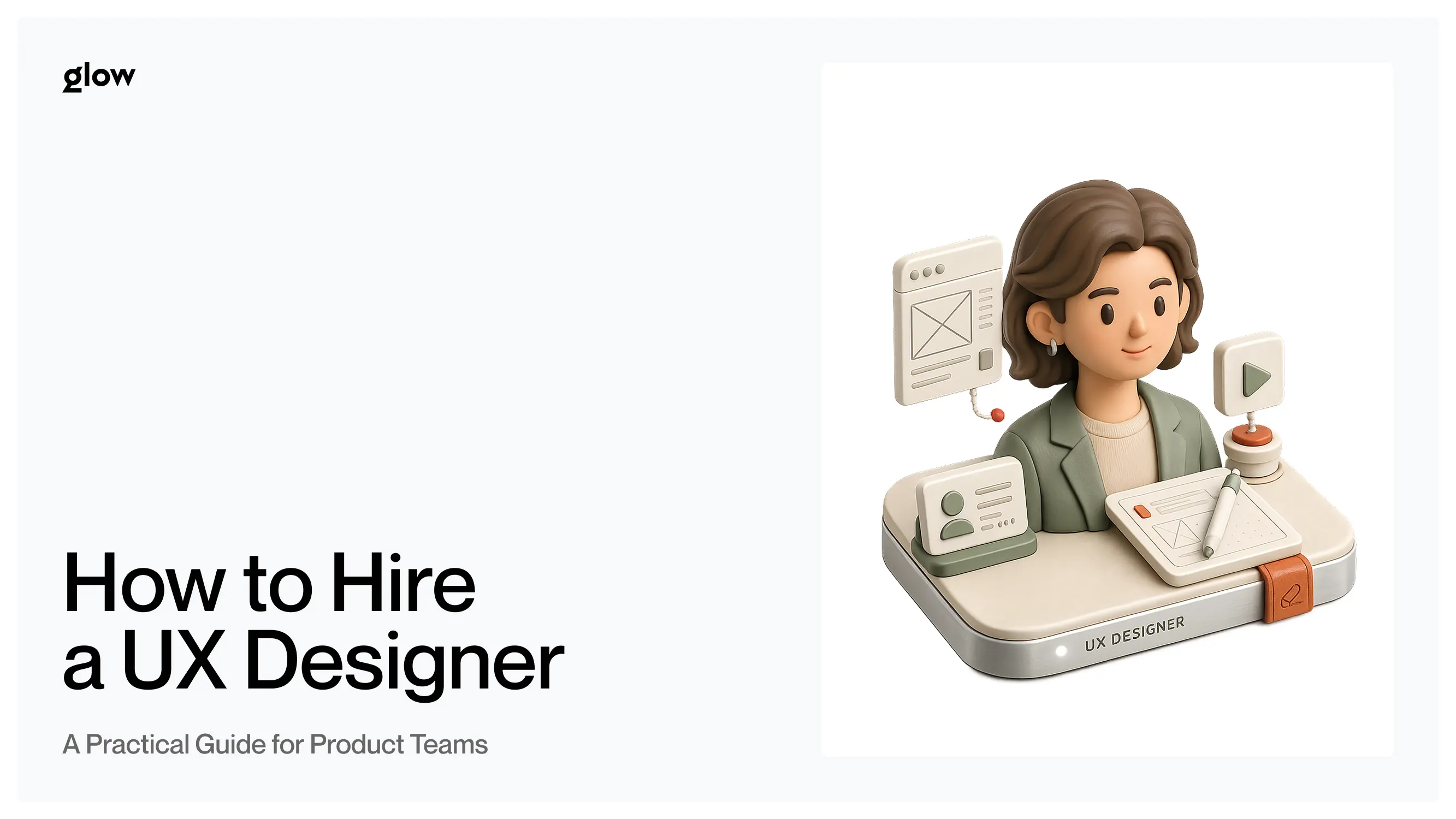

How to hire a UX designer without wasting two months on the wrong role. Skills, cost, portfolios, interview questions, and where to find real talent.
Most bad design hires trace back to a single mistake made before anyone read a resume. The job description said "UX designer" when the team actually needed a researcher, or a visual designer, or a product designer who could ship. To hire a UX designer who works out, you decide what the role really does day to day, then match every step after that (skills, portfolio review, interview, test task) to that decision. Skip it and you burn six weeks screening people who looked perfect and turned out wrong.
This guide walks through the full process the way we run it at Glow when clients ask us to help them build a design team or decide whether to hire in-house at all. No fluff about "finding a rockstar." Just what to look for, what to pay, and where the good people actually are in 2026.
Do you actually need a UX designer?
Before you post anything, answer one question: what will this person do between Monday and Friday? Write down a typical Tuesday. If the day is full of user interviews, journey maps, and stakeholder alignment, you want a UX researcher. If it is wireframes, prototypes, and Figma files, you want a product or UX designer. If it is color, type, and polish, that is a UI designer. These are different candidate pools, and posting for one when you need another is the fastest way to waste a hiring cycle.
The titles blur because the work overlaps. Here is the practical split.
UX vs UI vs product designer vs UX/UI

A UX designer works on how the product behaves. They run research, map flows, structure information, build wireframes and prototypes, and test them with real users. Their job is to make the thing easy and logical to use.
A UI designer owns the visual layer: layout, typography, color, spacing, components, and the overall look and feel. Strong UI work is what makes a product feel trustworthy and current.
A product designer follows the product across its whole life, from early concept through launch and beyond. They carry more responsibility for outcomes and usually sit closer to product strategy.
A UX/UI designer does both sides. This hybrid works well on small teams where one person owns the full experience. At senior levels the two skill sets pull apart, so a single "UX/UI" hire often ends up strong on one half and average on the other. On a five-person startup that tradeoff is fine. On a mature design org, specialize.
One honest check before you go further: sometimes the answer is that you do not need a full-time hire at all. A developer with good taste can handle a ten-screen internal tool. A product with complex workflows and external customers cannot be designed on the side. If design is a competitive edge for you, treat it as one. Our UI/UX design services exist for exactly the teams caught between "the dev handles it" and "we are not ready to hire."
What skills to look for when you hire a UX designer

Every candidate lists the same things: user research, wireframing, prototyping, Figma, "strong communication." That list is useless for sorting people, because anyone with six months of experience claims all of it. The real question is how deep each skill goes and whether it applies to your product.
Push on research execution, not research vocabulary. Ask about the last usability study they ran. How many participants, how they recruited, what changed because of the findings. A strong answer has numbers in it: "eight moderated sessions over two weeks, found three drop-off points in checkout, the redesign cut abandonment from 34% to 19%." A weak answer sounds like a textbook. "I empathize with users and understand their pain points" is a headline, not a skill.
Information architecture is an underrated filter. Can they take a messy product and organize it so a first-time user finds their way? We have seen designers ace every visual test and then fall apart organizing a dashboard, sorting it by internal team structure instead of by how the user actually works. Screens are the easy part. Systems that make sense to a stressed, distracted person are the hard part.
Figma fluency past the basics matters too. Knowing Figma is table stakes now. What separates people is whether they can build a real component library with auto-layout and variants, set up design tokens that map to the engineers' CSS, and prototype states and edge cases rather than click-through wireframes. Ask to see their file structure. Two hundred unnamed layers tells you more than a polished case study.
Two skills that were "nice to have" a few years ago are now non-negotiable. Accessibility: a designer who cannot explain contrast ratios, keyboard navigation, or screen readers will produce work that gets redone. Data fluency: not data science, but the ability to read a funnel, a heatmap, or an analytics report and decide what to fix next. The Nielsen Norman Group's State of UX reporting has flagged for a while that senior roles now reward analytical judgment over pure artifact production. Hire for the judgment.
Which seniority level do you need

"Senior" gets thrown on job posts like seasoning, and it costs you. A junior designer executes well with direction and is a great fit when you have a lead who can guide them. A mid-level designer owns features end to end and needs less hand-holding. A senior designer shapes the problem, not just the solution, and can push back on product decisions with evidence.
Match the level to the gap. If you already have a design lead and need hands, a mid-level hire stretches your budget further than a second senior. If design decisions are currently getting made by whoever is loudest in the room, you need someone senior enough to own them. Paying senior money for junior scope, or asking a junior to run design strategy alone, both end badly. Years of experience is a weak proxy anyway. A designer with four sharp years of shipped, constrained work beats one with eight years of concept redesigns.
Freelancer, in-house, or a design agency?

How you hire matters as much as who. The three models solve different problems, and picking the wrong one is a common reason a design search stalls.
- Freelancer. Best for one-off projects with clear scope: a redesign, a single flow, a landing page. Fast to start, no long commitment. Watch out for availability and continuity, since good freelancers juggle several clients and can vanish mid-sprint, with little accountability past the contract.
- In-house hire. Best for ongoing product work where deep context and cultural fit pay off over time, and strongest when you already have design leadership to guide them. Watch out for the cost and speed of hiring, and for betting on one person's range: a single in-house designer rarely covers research, UI, and systems equally well.
- Design agency. Best for teams that need senior craft quickly, want a full skill set (research, UI, systems, motion) without hiring three people, or need to move before an in-house search finishes. Watch out for fit, which varies a lot between agencies. Check that they work in your product space and timezone, and that you are getting a team rather than a single junior behind a nice logo.
There is a fourth option people forget: a fractional design lead, a senior who works with you part-time to set direction while juniors or freelancers execute. It is a good bridge when you need senior judgment but cannot justify a full senior salary yet.
An agency is often the pragmatic middle path for a growing product. You get a vetted team faster than a hire, you can scale up or down, and you skip the risk of one wrong in-house bet. That is the model we run at Glow: a fixed monthly rate, quick onboarding, and a team that plugs into your product across timezones. You can see the range of products we have shipped in our work, and if you want to weigh us against an in-house plan, our team is happy to talk it through honestly, including when hiring in-house is the better call for you.
How much does it cost to hire a UX designer?

Cost depends on experience, location, and how you engage. In the US, a mid-level UX designer runs roughly $90,000 to $125,000 a year, with senior designers reaching $135,000 to $180,000 in higher-paying sectors like fintech, healthtech, and enterprise SaaS. The US Bureau of Labor Statistics groups UX under digital designers and projects steady growth through the early 2030s, so demand is not cooling. You can check current figures on the BLS occupational outlook.
Two hidden costs are easy to miss. First, recruiting: a direct-hire placement through a creative staffing agency often runs $14,000 to $22,000 on a $110,000 salary. Second, a bad hire, which can cost around 30% of annual salary once you count onboarding, lost time, and the work a replacement has to redo. That math is why the model you choose is not just about the sticker price. A freelancer looks cheap per hour until you count the ramp-up on every new project. An agency's fixed monthly rate looks higher until you count what one wrong in-house hire costs. Hiring a designer in another region can cut rates significantly, which is part of why plenty of US and EU teams work with distributed agencies.
Where to find UX designers

The source matters more for design than for most roles, because a designer's LinkedIn tells you almost nothing. The work lives in portfolios and communities.
Design platforms are the first stop. Behance has the deepest case studies, so filter for people who post problem statements, research, and outcomes, not just final screens. Dribbble skews visual and is strong for UI and interaction designers, weaker for researchers. The Figma Community is underused for recruiting: designers who publish components and design systems are showing you exactly the systems thinking a production role needs.
Communities like ADPList and designer Slack groups surface senior people who stopped job-hunting on generic boards years ago. They move for something they hear about through their network, so reaching out directly works better than a job post. It takes more effort and returns higher quality.
Referrals and reference platforms close the loop. Ask your network first, the way you would for any specialist. For agencies and vetted freelancers, B2B review sites like Clutch let you read real client feedback before you reach out. If your search is for a partner rather than a single hire, that is where evaluating an agency's track record beats scrolling portfolios.
How to evaluate a portfolio: process over polish

A portfolio is the first thing you look at and the easiest thing to misread. A polished case study is a curated story. The messy parts, the vetoed idea, the research that got cut for timeline, all edited out. Your job is to look past the presentation for evidence of real thinking.
Look for structure and storytelling. A good case study shows how the designer arrived at the result: the competitor analysis, the information architecture, the wireframes, what problem each decision solved. Screens with no process behind them tell you someone can decorate, not design. As one of our lead designers puts it, the question you want answered on every project is "why did you do this," and a strong designer answers it without reaching for the word "clean."
Watch for concept-only portfolios. A folder full of "I redesigned Spotify" with no shipped work means the person has never dealt with real constraints: engineering limits, accessibility rules, a PM who changes the brief midway, a legacy system that will not support the pattern they want. Concept work is practice. You are hiring for the game. And check the portfolio against whatever they produce later in the process, because a portfolio can be polished for a year while a live task shows their actual current level.
Interview questions that reveal real skill

Portfolios show the highlight reel. The interview is where you find out what actually happened. These are the prompts that separate depth from polish, grouped by what they expose.
On research and honesty, ask: "Walk me through the last time you changed direction mid-project because of something user research told you." You want a real pivot with a finding that surprised them. "We confirmed our hypothesis" is confirmation bias, not research.
On process and judgment, ask: "Show me a project where the final design was very different from your first concept. What changed?" A designer who has never killed a darling has either been designing in a vacuum or getting no feedback. Follow with "How do you decide a design is done enough to hand off?" The best answers treat "done" as a tradeoff between quality and shipping, not "when stakeholders approve."
On collaboration, ask: "Tell me about a time a developer pushed back on your design." The answer shows whether they see engineering as an enemy or a partner. "I explained why I was right and they built it" is a flag. "We found a middle ground that kept the core interaction but cut the front-end cost" is what you want, because it means they understand implementation cost is a design variable.
The single most useful format is a live portfolio deep-dive instead of a take-home. Pick one case study and drill into the parts that never made the slide: What did you cut, and why? Which version got rejected? Which metric moved after it shipped? Who on the team disagreed? A person who did the work answers all four with specifics. Someone who rode along on a team's output gets vague after the second question.
The test task, and when to skip it

A small, relevant test task is a fair way to see how someone thinks with a real problem in front of them, especially for junior and mid-level roles. Keep it realistic and tied to your product, give clear instructions and a timeline, and offer to discuss their approach afterward. What you are grading is not the visual output. It is whether they did what was asked, asked good clarifying questions, and can explain their choices.
Two things to remember. First, senior designers with several offers often will not do spec work, so for senior roles the portfolio deep-dive usually replaces the take-home. Second, mind the form of delivery. A Figma file lets you see edit history and interact with the work. A flat PDF for a design task is worth a second look, because it hides the process and, occasionally, the fact that the work is not theirs.
Red flags to watch for

Some of these you would catch on your own. Most you will not, until the person is already on payroll.
A portfolio with no case studies, only final screens, means you are guessing about their UX skill. Justifications that always come back to aesthetics ("I chose this because it looks clean") point to a visual designer, not a UX one. A candidate who asks you zero questions about your users, product, or goals is showing you how they will work: waiting to be told what to design instead of finding what needs designing. And tool obsession ("I only work in Figma, I refuse to touch anything else") signals someone who will create friction with your team from day one. Tools are tools. The underlying skill is spatial reasoning, interaction logic, and user empathy.
One more, easy to rationalize away in the moment: the test task that comes in far below the portfolio's level. Nerves and deadlines explain a small gap. A large one usually means the portfolio is not an honest picture of what they can do right now.
How long it takes, and a note on onboarding

For a mid-level role with an accurate description and competitive pay, expect 30 to 60 days. Drag past that and the cause is almost always positioning: the title is wrong, the salary is below market, or the job description is three roles stapled together. We have seen a senior role sit open for four months at a salary $35,000 under market, then fill in three weeks once the budget matched reality.
Hiring is not the finish line. The first two weeks decide whether a good designer becomes a productive one. Give them a real project quickly, not a month of reading docs. Pair them with someone who can answer product questions. Be explicit about what "good" looks like on your team, since design quality is subjective and unspoken standards cause slow, quiet friction. If speed of ramp-up is the whole reason you are considering an agency, that is fair: a team that has onboarded onto dozens of products tends to get useful faster than a single new hire finding their feet. Our AI and product design work is a good example of how quickly an experienced team can pick up an unfamiliar domain.
Frequently Asked Questions
What is the difference between a UX and a UI designer?
UX is the research, strategy, and structure: how the product behaves and whether it is easy to use. UI is the visual execution: layout, color, typography, and components. A UX designer might decide checkout needs three steps instead of five; a UI designer decides the button is 48px with a specific radius and color. Some people do both, but at senior levels the skill sets diverge, so hiring one role expecting both often gets you someone strong on one half and average on the other.
How much does it cost to hire a UX designer?
In the US, roughly $90,000 to $125,000 a year for mid-level and $135,000 to $180,000 for senior, varying by industry and location. Add recruiting fees if you use an agency, and remember a bad hire costs about 30% of salary to unwind. Freelancers and design agencies with distributed teams can lower the effective rate, which is why many teams use them for flexibility.
Where can I find good UX designers?
Start with Behance and the Figma Community for portfolio depth, Dribbble for visual and interaction designers, and communities like ADPList for senior people who are not actively job-hunting. Referrals and B2B review sites like Clutch work well when you are evaluating agencies or vetted freelancers rather than a single hire.
Should I give candidates a test task?
Yes for junior and mid-level roles, since a small, realistic task shows how someone thinks and handles a brief. Keep it scoped and relevant. For senior roles, a live portfolio deep-dive usually works better, because strong senior candidates with multiple offers often decline spec work.
Do I need a UX designer, or can a developer handle it?
It depends on the product. A simple internal tool with a handful of screens can be handled by a developer with good design sense. A customer-facing product with complex workflows, or one where experience is a competitive edge, needs a dedicated designer. A developer doing UX on the side tends to ship functional interfaces that nobody enjoys, which quietly costs you users over time.
How long does it take to hire a UX designer?
Usually 30 to 60 days for a mid-level role, assuming the job description is accurate and the pay is competitive. If a search drags longer, the problem is almost always the positioning: wrong title, below-market salary, or a description covering several different roles at once.
Hiring the right UX designer comes down to knowing what the role actually does, then testing for process instead of polish at every step. If you would rather skip the two-month search, or you want a senior team you can start with in days instead of months, get a quote from Glow or start our 3-day free trial. No charge, no commitment, just a chance to see how we work on your real product before you decide.

.svg)

Related Articles Prompted by Glow











Get weekly glow prompts—
insights from the frontline of product design
Check your inbox for future updates.

No spam.
Just sharp insights that make you better at design & AI.
Want results like this? Book a call
Let's talk through your product in 20 minutes — no briefs, no fluff. Just a real conversation.